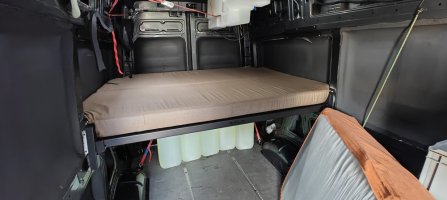
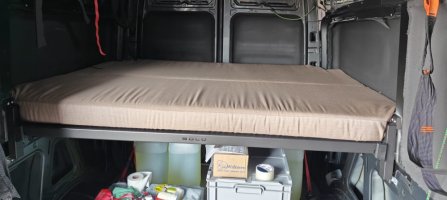
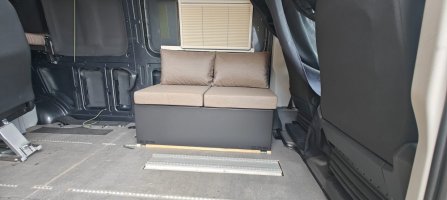
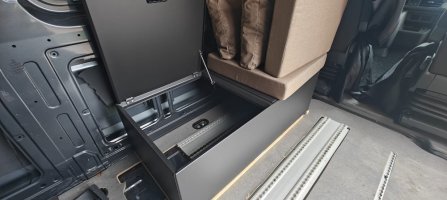
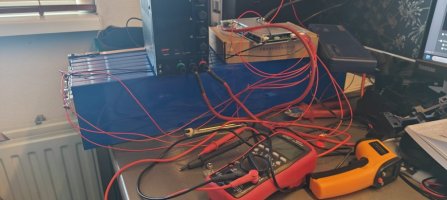
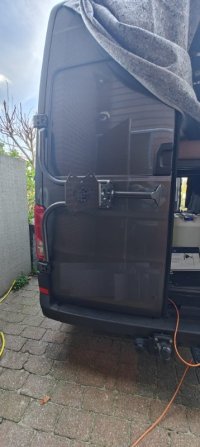
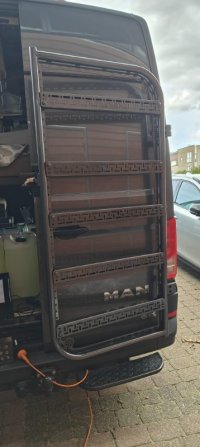
2024 MAN TGE L4H3 4x4 build

And a small update on the Gen6 Haldex controller by Veer Engineering as mentioned in this topic: Hello everyone

Jeroen told me today that he's having the hardware built for the Gen6 Haldex right now and will be able to test it over a short period. When available I'll purchase a set as it enables besides locking the diff, which is also possible with the OEM button in the dashboard, you can set the percentage that the diff engaged in steps of 10% and you can preset % at certain speeds.
It makes the now 'engage only when the front wheels slip' to a 50% permanent powered rear axle.

difflock button.png
 
  • Like
Reactions: Wbm
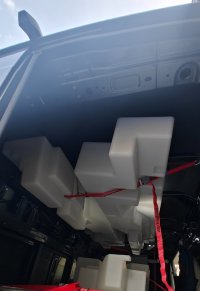
Last chance to get goods from Andorra Campers such as the 133L / 110L water tanks. I'm heading to Andorra la Vella on Saturday the 21st and picking up the items on Saturday the 28th and arriving in The Netherlands on Sunday the 29th. Goods are ready for pickup from Monday the 30th onwards.

Original link: 2024 MAN TGE L4H3 4x4 build
 
The battery will be heated/cooled with coolant, see the drawing:
The idea behind this is energy conservation: it takes remarkably little energy to run an extra piece of pipe with coolant and use the residual heat to bring the battery to a constant 25°C. Due to the shape of these cells, it would be energetically a very bad idea to work with electric heating mats — you would need an extreme number of them, causing the base load to go somewhere toward 14×20W or even 21×20W just to get the battery up to temperature. It would also take may hours to get ip up to the required temperature.

In addition, when I run a 5kW liquid heater, I will need roughly 3kW of heat to warm up the van around freezing point. The rest I can “lose” (usefully) through the return loop via the fresh water and grey water tanks as well as the battery. The battery will only have a heating demand when it is too cold, and by insulating the battery well it will also stay warm for longer. The battery can also warm itself up when delivering a lot of power over an extended period. The battery can operate up to about ±55°C and it will be shut off by the BMS at ±60°C, but it can also be cooled using the coolant — in that case the heater is turned off and the convectors run at full speed to dissipate the heat.


View attachment 1470


Legend:

  • Yellow: 20mm XPS
  • Orange: 1.5mm copper L-profiles for heat transfer between the heat exchanger and battery cells
  • Light blue: Battery cells 1 to 8
  • Grey: Heat exchanger
  • Red: hot coolant IN
  • Blue: cold coolant OUT

The temperature control will be handled by the Pekaway VanPi and RTL threeway electrically controlled valves at the battery itself.


===


The heat exchanger is undergoing design as we speak and when dimensions are final the alloy box will be engineered. It will feature a thick underside to prevent penetration by terra and the BMS will be mounted to the inside of the box and outisde of the XPS-insulation to make the box the massive heatsink for it. It will be in the shadow and have aircooling most of the time. It will also be reflective to prevent heat from hot asphalt in the French Aires to soak into the alloy and prevent the BMS from shutdown due to heat problems.

What cells do you use in that pack? I would be very uncomfortable to run the cells at 55C. Most of degradation happens at elevated temperatures.
Also, if the cells casings are ally, I would put some insulation separators between cells and the copper profiles.
 
@Raul a/3 the specs can be found here: Ombouw MAN TGE: 24V huishoudaccu - Pagina 46 - camperforum.nl

And no, 55C is the shut down upper limit and normal operation temp is 25C. Once the system is built and operational I need to do tests to see how much the cells will heat up under load to keep them afloat in a comfy temperature bandwidth, for instance, heat them up to 25C and when cooking on the induction cooktop drawing up to 2kw to see what happens. I can set temp profiles to lower the heat before cooking for instance to 15C to compensate for possible excess heat production. Or just extract heat by shutting the heater off and activating the convectors to max while opening the battery heating loop, that otherwise be closed during internal warmup. (If the coolant temp is lower than the battery offcourse).

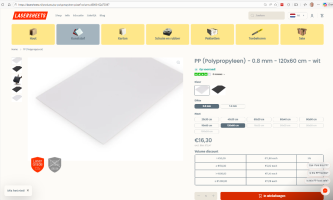
The cell casings are the standard blue plastic, I'm putting a sheet of clear plastic folder between the cells and the heat sinks. This is a recommended material, polypropylene. Extremely thin, no heat loss in transfer, with all the isolation gains of a protectant.

2026-02-16_10h50_25.png
 
Last edited:
I think they are CATL prismatic blade. I have some long experience with the more common shape casings. I built quite few house storage batteries with EVE cells. The cells will expand 1-2mm during normal operation, and you definitely need some strong insulators between casings. The existing blue shrink wrap is not man enough. The outer ally casing is positive grounded on each cell.
On JK bms avoid firmware 24 and 26. I use, and set my batteries with the PB series V19. I have bricked one, but now I managed to force update the firmware.

It would be nice if you could achieve some active cooling as reverse to heating. That would be the icing on the cake.
 
Yes, they're CATL cells and thanks for the feedback on cell expansion, I have these copper heat sinks to put between the cells and the whole pack will be bound together to stay tight, using a couple of pallet securing straps for instance. They are light and strong. Maybe it will become a thread based solution, I'm not at that point yet... Cells need to be pressed tightly together within a case.

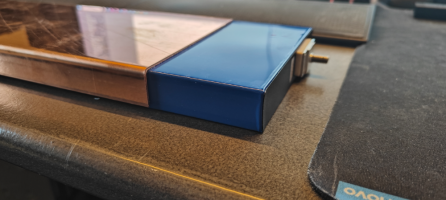
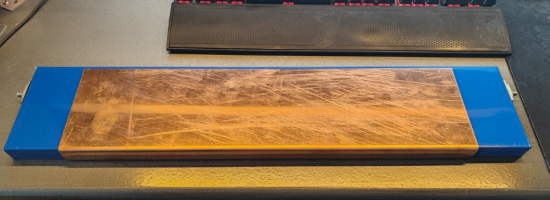
The copper heat sinks double as an insulator with the polypropylene inserts, that will keep everything in place and prevent electrical problems, in other words they:
  1. keep the cells in their original form to prevent degradation,
  2. insulate the cells from electrical hazard,
  3. transfer heat from the heat exchanger below into the cells / remove heat when coolant is applied which is cooler than the cells.
Why did you ground the case on the cells? All my grounds are moving into the vehicle using two automotive connectors, one for the DC + and - and one with some 24 connections for the three way valves, the BMS data connection, the temp sensors etc.

If you advise me to use thin PP sheets I might use these to distance the copper from the cells, it will widen the total battery by (0,8mm * 16 sheets =) 12,8mm which is not an issue in the total design.

2026-02-16_11h16_46.png
Note: the copper hasn't been prepared yet, the sides need to be sanded down to prevent abrasive parts on the edges.

2026-02-16_11h16_37.png

2026-02-16_11h52_24.png


One benefit of my future system is that it runs on 24V --> each cell will provide +- 10,4A each under full load (= max A's in power used in the vehicle), totalling some 83A for 8 cells or 2000W delivery in total which means the cells are never under their full electrical capabilities which prevents thermal issues. This battery should be able to deliver way more than I will ask of it.
 
Last edited:
Why did you ground the case on the cells?
I didn't, they done at factory, if you put the meter from case to positive terminal, you get continuity; and from negative terminal to the case you get about 2V. Hence the outer case needs to be well insulated, individually and as a pack.
 
Can you elaborate on which battery you have so I can understand this method?

My cell pack will be thermally and electrically isolated from the outside shell and grounding will be done on the chassis of the vehicle.

In a way it will act like any plastic housing but in this case constructed from aluminium. The only components mounted to the battery outside shell will be the two connectors and on the inside the BMS. I will place it outside the XPS pack but on the inside of the shell to exclude it from getting warm from the battery and being able to use the shell as a heat sink, to cool down the BMS when needed. A second plate will be welded on the inside and will have threads to mount the BMS to. That will ensure a nice large heat sink. The outside of the shell will be covered in heat reflective wrapper to prevent summer asphalt heat to alter the temperature of the shell and negatively influence the BMS.
 
with EVE cells. The cells will expand 1-2mm during normal operation, and you definitely need some strong insulators between casings. The existing blue shrink wrap is not man enough. The outer ally casing is positive grounded on each cell.
My experience is with EVE MB30 and MB31 cells.
The grounding is not something you want to do, is the way the cells are built, and be mindful, that from cell to cell you need electrical isolation;
 
Back
Top