2024 MAN TGE L4H3 4x4 build

Lebowski

Active member
Pro
I have a build thread on camperforum.nl and I will post some updates here to keep everybody happy. My introduction thread can be found here.

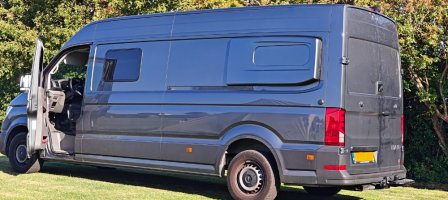
My van is a 2024 'Next Level' facelift model with a 4x4 system, in length 4 and height 3, or L4H3 in short. I bought it new as I found it difficult to find a high quality used van with the right features, them being the upfitters module under the drivers seat (in your case the passenger seat) as I have an LHD vehicle and a have a diff lock and suspension seats for comfort.

The final form of the van will be a mix of LCV and campervan as I need to be able to move goods too. Because of this I will create a build that is flexible and light in weight and I will retain the floor fixating points. These vans are heavy and mine weighs according to the COC 2640kg. I went to the skip and weighed it and was told 2650kg, but that;s probably my gut being a little heavier than the standard 75kg added as the driver weight.

This means according to my calculations that the heaviest dry weight I can be is 3167kg to be able to take enough people, luggage and water AND stay under 3500kg.

In The Netherlands uprating means you also need a C1 licence limiting the demographic that is willing to purchase my van when I move to the next one. Also you can only drive 90 km/h max and pay higher tolls on the EU-roads. And the wife needs a C1 licence too in case of emergencies as legally she won't be allowed to drive a C1 vehicle with a B licence.

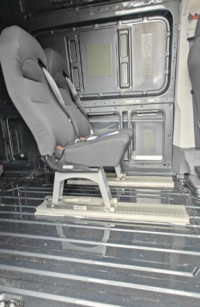
I have already added Schnierle seats in the back and they can be taken out in 10 seconds resulting in a huge cargo space.
Then Dometic windows were ordered and one was placed inn the vehicle and one was lost in transit.
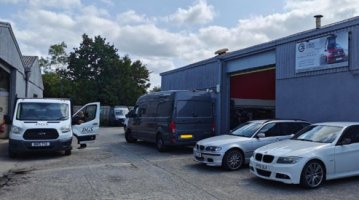
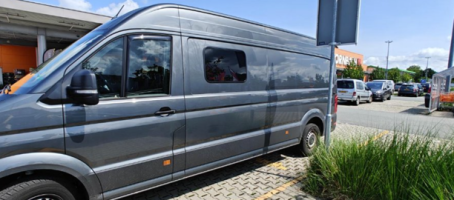
Now the van is parked at CJL Leisure to fit flares as I want to sleep sideways to maximize the inner space.
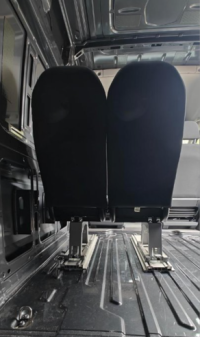
Schnierle back.png
The rails have been placed in such a way that you can put one Euronorm crate between them and use the C-track eyelets to secure it with a bungee cord or a ratchet strap. The intention is to not have ONE part of wood in my vehicle, especially on the floor.
Schnierle sides.png

Dometic S7P 750 x 465mm.png


My MAN TGE at CJL Leisure.png
 
Last edited:
I picked up the van this morning at 1145 and the flares are on the vehicle now, I'm happy as I can proceed to insulate this part too, that should make quite a difference in noise transmission but also creation.

IMG_20250808_225915.jpg
 
Last edited:
@rod_vw when you have seat cables available for the swivel seats I'd like to buy a set for two massage suspension seats. Don't know how many pins are populated but my guess is all of them.

I read about your venture and ice purchased a set of Audrio swivels and found that the cables are too short to swivel 180 degrees.
 
@rod_vw when you have seat cables available for the swivel seats I'd like to buy a set for two massage suspension seats. Don't know how many pins are populated but my guess is all of them.

I read about your venture and ice purchased a set of Audrio swivels and found that the cables are too short to swivel 180 degrees.
Hi @Lebowski , is it the red 17 way connectors that you have under those seats? If so I am hoping that the ones that I am developing for the twin seat swivel will have all 17 wires populated with the same wire cross section as shown on genuine wiring diagrams. Time will tell how this all works out and what length extension loom would be needed for your type of seat. Please keep in contact but remember that I'm on holiday from the end of this week until the first week of October, six weeks in Europe with the TGE :).
 
I've got to pick up some goods (wheel carrier + luggage rack) at Wheeliams in a couple of days but haven't heard anything from them, on their website is just an administrative address, a residential home. Does anyone have their phone number and workshop address?
 
Never mind: I did get a reply but unfortunately due to bad internet reception email delivery was slower than usual
 
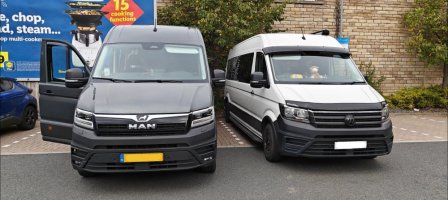
Yesterday in Alnwick; was parked at the local Lidl when a fellow Crafter van parked next to me. Maybe he's also on the forum?
We went to Alnwick Castle to see the Harry Potter sights and undergo broomstick flying training, the kids had fun and so did we!

There was a troupe of four men doing comedy with kids called the Silly History Boys and they also have a podcast, started listening to them and they rock!


Today: Picked up the goods at Wheeliams' workshop in Scarborough and chucked them in the van, will send them to powder coaters when at home but have to decide on the colour:
1: black, not very original
2: a near identical colour to Indium Grey to hide the parts from plain sight.

parked in Alnwick.jpg

Wheeliams' workshop.jpg

Silly History Boys podcast - give them a listen.jpg
 
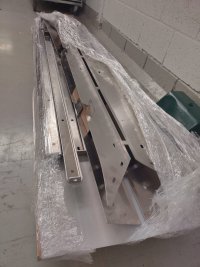
Things are starting to come together more and more. The custom-made roof rack has been delivered to the designer, Jeroen, also known as VNK on the Dutch forum.

Jeroen designed the roof rack in such a way that there’s enough height to fully open two Maxxfan Domes under the panels, lights can be mounted on the sides and back, and there’s space for a keder rail on both sides. An awning of this length weighs about 35 kilos, which is simply too heavy and not flexible, so we opted for a fabric solution that weighs just a few kilos. You’ll need a telescopic ladder for it, but that’s handy to have anyway.

The roof rack is designed for the Craig Solar solar panels I bought in England last month. They measure 147 x 67 cm, and four of them fit in a row, giving me 800Wp of power generation on my roof soon. Behind them, there will be a Maxxfan Deluxe Compact in the color smoke. To the left, there’s a streamlined aluminum box for a kinetic tow rope and some other stuff, and to the right, two recovery boards in an identical box with a Starlink on top. The boxes will be slightly higher than a closed Maxxfan, so the plastic cover isn’t the highest point on the roof, and the boxes can absorb any impact from branches.

At the back, there will be separately switchable floodlights for reversing in the dark, and a rearview dashcam for evidence against reckless drivers on the road. Of course, there will also be a dashcam behind the windshield, but that’s not the topic right now.

Another huge advantage of this roof rack is that it weighs only 14.7 kilos and has a spoiler to minimize air resistance. There’s no lighter roof rack available for purchase.

In two weeks, I’ll pick up the parts and bring them, along with the Wheeliams products, to the powder coater the following week to have them coated in RAL7024 (Graphite Grey) dark grey. I’m counting on a few weeks for that as well, so installation won’t start before mid-October. After installation, the Maxxfan Domes will also be fitted into the roof, as then I’ll know for sure they won’t be placed where a solar panel mount is.

Price: € depends on the daily aluminum prices, which fluctuate quite a bit. My roof rack is slightly cheaper than future racks since it’s a prototype.

After this rack is done, we’ll work on a few more products, namely two boxes for the roof and a battery box under the vehicle. That’s going to be a very interesting project too, which I won’t say anything about yet, but it’s going to be VERY cool!

@everyone with a Crafter / TGE L3 or L4: this roof rack was made for the L4 and can be ordered from Jeroen, also for the L3. He’ll make a shorter version for that.

Roof rack - cut and shaped.jpg
 
Last edited:
Things are starting to come together more and more. The custom-made roof rack has been delivered to the designer, Jeroen, also known as VNK on the Dutch forum.

Jeroen designed the roof rack in such a way that there’s enough height to fully open two Maxxfan Domes under the panels, lights can be mounted on the sides and back, and there’s space for a keder rail on both sides. An awning of this length weighs about 35 kilos, which is simply too heavy and not flexible, so we opted for a fabric solution that weighs just a few kilos. You’ll need a telescopic ladder for it, but that’s handy to have anyway.

The roof rack is designed for the Craig Solar solar panels I bought in England last month. They measure 147 x 67 cm, and four of them fit in a row, giving me 800Wp of power generation on my roof soon. Behind them, there will be a Maxxfan Deluxe Compact in the color smoke. To the left, there’s a streamlined aluminum box for a kinetic tow rope and some other stuff, and to the right, two recovery boards in an identical box with a Starlink on top. The boxes will be slightly higher than a closed Maxxfan, so the plastic cover isn’t the highest point on the roof, and the boxes can absorb any impact from branches.

At the back, there will be separately switchable floodlights for reversing in the dark, and a rearview dashcam for evidence against reckless drivers on the road. Of course, there will also be a dashcam behind the windshield, but that’s not the topic right now.

Another huge advantage of this roof rack is that it weighs only 14.7 kilos and has a spoiler to minimize air resistance. There’s no lighter roof rack available for purchase.

In two weeks, I’ll pick up the parts and bring them, along with the Wheeliams products, to the powder coater the following week to have them coated in RAL7024 (Graphite Grey) dark grey. I’m counting on a few weeks for that as well, so installation won’t start before mid-October. After installation, the Maxxfan Domes will also be fitted into the roof, as then I’ll know for sure they won’t be placed where a solar panel mount is.

Price: € depends on the daily aluminum prices, which fluctuate quite a bit. My roof rack is slightly cheaper than future racks since it’s a prototype.

After this rack is done, we’ll work on a few more products, namely two boxes for the roof and a battery box under the vehicle. That’s going to be a very interesting project too, which I won’t say anything about yet, but it’s going to be VERY cool!

@everyone with a Crafter / TGE L3 or L4: this roof rack was made for the L4 and can be ordered from Jeroen, also for the L3. He’ll make a shorter version for that.

View attachment 1338
This sounds good! Will await pictures with interest @Lebowski
 
Another group buy!

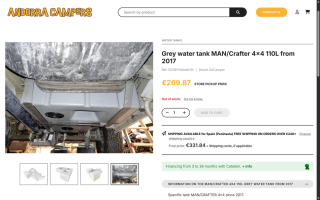
Due to not being available on the Northern European market, I'm going to Andorra to buy two tanks for myself for my MAN TGE L4 4x4. Therefore, it seems to me that it won't harm the forum sponsors.

Andorracampers supply these tanks for the VW Crafter 4MOTION and MAN TGE 4x4 LENGTH 4 with all-wheel drive.

110 litre:
  • Specific tank MAN/CRAFTER 4x4 since 2017.
  • For grey water.
  • Capacity: 110L.
  • Weight: 11 Kg.
  • Dimensions: 1010x310x730mm.
  • Material: Polyethylene (PEMD) with UV filter and antioxidant, food-grade plastic.
    Installation: Mounted on the left side between the rear wheel arch and the diesel tank.

VW Crafter MAN TGE 110L water  tank.png

Source: Gray water tank MAN/Crafter 4x4 110L from 2017
.
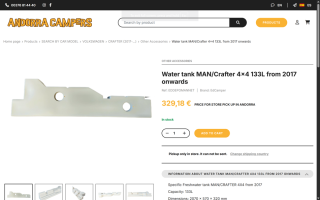
133L:
  • Specific Freshwater tank MAN/CRAFTER 4X4 from 2017
  • Capacity: 133L
  • Dimensions: 2070 x 570 x 320 mm
  • Weight: 18kg
  • Material: Polyethylene (P.E.M.D) with UV filter and antioxidant, plastic for food use.
  • Installation: It is installed in the underbody of the vehicle, passenger side, under the sliding side door.
  • Mounting kit Water tank MAN/Crafter 4x4 133L
  • NOT VALID FOR 2WD and L5
VW Crafter MAN TGE 133L water  tank.png
Source: Water tank MAN/Crafter 4x4 133L from 2017 onwards


The prices mentioned below are local pick up from the store in Andorra, excluding shipment. Shipping two tanks via a transport company costs approximately €600.

Tank
  • 110L: € 269,87
  • 133L: € 329,18
Mountkit
  • 110L: € 85,70
  • 133L: € 93,05

The final price is not know yet, I'm enquiring.


There aren't many Crafter L4 4Motions or TGE L4 4x4s out there, which makes this a niche item, but if you have one of these vans and want 1 or 2 of these tanks, let me know. Reply with which tank you want: the 110L or 133L variant, or both. A mounting kit is always included.

I will enquire at Andorracampers what they can do with the cost and depending on how many I need to take with me the individual shipping cost decreases with each buyer.

Import tax into the UK: put the tanks under the vehicle in The Netherlands and no-one knows you have a tank with you and no highway robbery takes place.
 
Last edited:
Hi @Lebowski I've completed the plug & play extension for the R&J swivel and am fitting it for the customer this evening, please drop me an email if you are still interested in the shorter version for the swivels in your new camper. My email is [email protected]
 
Today, the supplying dealership rang me about tyre sizing, he explained that within the EU a certain tyre size is homologated, that comes down to being able to fit tyres that are some 6% oversized compared to the OEM 235/65 R16 tyres.

He told me that Norway has the same problem, they want to be able to drive through mud/bogs and have big aired down tyres for that.

The UK, not being part of the EU can set it's own homologation rules and opt for a different tyre size. If the UK dealers / third party suppliers can offer a solution to fit 245/70 R17 (+8,9% compared to OEM) tyres it is up to the UK to enable this and I can try to have my software updated with this software at my own risk. Nothing really changes in the ECU apart from tyre size and how the safety systems interact, in case of the tyre size agreed for the UK market the safety systems are also adapted for the new tyre sizes. I lose my homologation theoretically as my vehicle, when loaded with UK software, no longers subjects to EU regulations. This is a bureaucratic statistic that's never checked in reality, not during a possible weight check, not at MOT-time. The ECU is scanned for fault codes and emissions and that's it.

If I can load UK-specific tyre software blocks into the ECU then I can finally have my 245/70 R17 on my vehicle and raise it by 4 or 5 cm due to the higher tyre. I will visit the UK again in summer, and head up to Scotland for a three week holiday if this is possible soon, in case my own dealer is unable to load UK-software into my vehicle.

Besides this, I also enquired about the factory option to raise the vehicle by 30mm, I'd like to fit this too. I am aware of many aftermarket kits that are out there and most need a form of fabrication as they seem to be made for the old Mercedes Sprinter / VW Crafter (previous generation up to 2017) but are marketed as 'specific for Crafter/TGE 2017+' which they obviously are not, otherwise it would be a direct fit. Many lift kits also do not supply a drive shaft shimmy resulting in a joint that's operating under a too steep angle which enables faster wear and tear.
He'll get back to me about this and I will keep him updated about the UK tyre block.

My other option is to use 225/70 R17 tyres which are just as good as the larger tyres traction wise off road as a narrower tyre will flex more when aired down, bit they do not have the extra ride height I'm looking for. I want to maximize as I can be improved.

Conclusion:
The main goal for this posting is that I need your help to inform me when/if 245/70 R17 can be used in the UK soon by means of a software update.
 
I have a request (to someone that bought a new van in the last year or two): is somebody willing to ask their dealer for the contact details of their technical lead? I want to see which tyre sizes are legislated in the UK and if they are larger than the european 235/65 R16 I'd like to know about it as I want to recode my ECU with larger tyre sizes.

I hope to be able to program 245/70 R17 into my ECU. (see this message, #15)

My vehicle is a Next Generation with build date late 10-2024.
 
Some updates from my side of the pond:

HHB Update:
It's time for an update on the HouseHoldBattery (HHB). Almost from the moment I started I've been trying to figure out how to calculate which battery size I needed. I've learned a lot about this topic on the Dutch camperforum. I've had useful discussions about which fuel type to choose for heating and which for cooking, the weights of the installations per fuel type, as well as the availability of various fuels. As a result, I've opted for a full-electric setup for the household part and built my van accordingly. Check the first page of my Dutch thread to quickly jump to the relevant sections and read my thoughts and feedback on them.


Production and Consumption:
Based on the roof plan (4x 200Wp), the alternator capacity (Euro 6, 250A), my travel profile (at least 2x half an hour of driving per day in winter, and several days of standstill in summer), and the table of consumers (388Ah max per day), I proposed a battery size and discussed it with an expert. He thought my battery could be 50% smaller (!!!), and so it was done.


A Little Thought Jump:
What I do "miss" in my vehicle is the ability to monitor on a screen not only the voltages from the alternator but also how many Amps the vehicle is drawing, how many Amps the alternator is producing, and how many Amps the Starter Battery (SB) and Accessory Battery (AB) are supplying. This would be the vehicle-equivalent of the Victron Ekrano or Cerbo GX—or you'd have to add this information to the Pekaway Core Pro using current clamps. Anyway, let me ask Pekaway about that...

Why do I want to know this? I'm used to being able to see everything (electricity generation/consumption and water usage) in my home installation via Homewizard mid-meters, smart plugs, and the P1 meter—so why not here too?


The Cells:
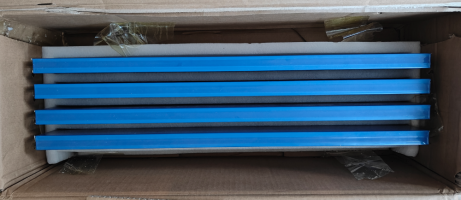
I bought 8 pieces of the BYD Blade 184Ah cells. A 24 Volt system is being built with these products: 184Ah Prismatic BYD Blade cell, and this is my order.


4 van de 8 cellen.png


Why am I choosing a 24V battery?
The choice for a 24V battery is based on the following reasons:
  • The primary use of my installation is remote working—that means laptop/screen/Starlink, and they are all happier with a higher voltage than 12V.
  • Most components are also available in 24V; only the 2x MaxxFan Dome+Light, the 1x MaxxFan Deluxe 36*36cm, and the 1x OGO Composting Toilet are only available as 12V.
  • The cabling becomes much thinner, making the components easier to connect. The connection from battery to inverter now only needs ±35mm² instead of ±90mm². This isn't done to save costs, but to have less voltage drop overall in the entire path and to make it easier to find the right terminals and plugs.
  • Batteries are often placed under the front seats, but that isn't possible in my van because I have two suspension seats, which only offer 9 or 10 cm of useful space at the foot.
  • In addition, I want the centrifugal force / centre of gravity as low as possible in the van, so I don't choose a battery/water tank on top of the wheel arches. The water tanks will be placed between the axles, outside, and the battery will be behind the rear axle against the floor. A battery has a fixed weight and therefore doesn't cause a difference in balance between the front and rear axle like a water tank behind the rear axle does. By placing the water tanks between the axles, the axle load will increase roughly evenly as the tanks are filled.
  • There will be 2x Victron XS1400 near the alternator, which will boost the alternator voltage of ±15.3V to double, in line with the LiFePO4 charging profile. This results in 7 metres of cabling at ±10mm² instead of 35mm².
  • My 4x Craig Solar panels have a Voc of 23.6V (open circuit voltage) and Vpm 19.5V (maximum power voltage), so in 4S or 2S2P configuration, both result in a voltage at least 5V higher than the MPPT needs to start. As long as there's still 1V higher than the maximum battery voltage of (8x 3.65V) = 29.2V, you're good for charging. Using 4S makes the MPPT start earlier because the MPPT start voltage is reached sooner.
  • The LED strips with the nicest light from the best cells are the 24V versions, and I'll need about three metres of strips across the ceiling anyway.
  • My thoughts are confirmed by the Victron Wiring Unlimited book.

Costs:
The costs for the cells, transport, and customs clearance total €582.56. €566.99 (8x cells, 18x plastic spacers, 7x connectors, transport) at the exchange rate of August 28, 2025, plus payment costs €15.57, so together €582.56 for 8x 184Ah @ 3.65V = 368Ah @ 14.6V or 184Ah @ 25.2V. If you calculate it back to € per Ah, it's €582.56 / 368Ah = €1.58 per Ah, which makes €158.30 per 100Ah of cells at the 'normal' 12V voltage.By the way, the initial quote for 4 cells and shipping by air freight was US $300 and by sea freight US $110.


The Electrical Installation:
The installation will be further built with Victron and Pekaway components, and a future topic will follow about it naturally. For now, I'll limit this message to the battery cells. The design of the battery enclosure and temperature management will be discussed in a future posting.
 
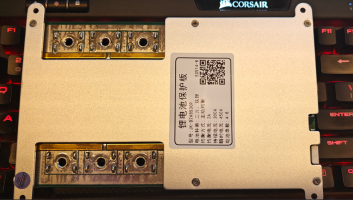
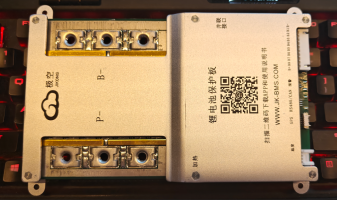
The HHB will be delivering a lot of power at times and for this I chose the JK-B2A8S30P BMS, it can handle up to 300A without any problems.
The benefit of having a 24V system is that the amperages are halved meaning it will 'only' deliver around 80 or 90A under full load. Coupled with the 'C' (dis)charge rating across several temperture ranges I will end up with a system that can deliver full power at any outside temperature.
JK-B2A8S30P BMS - onder.png
JK-B2A8S30P BMS - boven.png
 
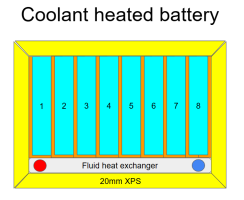
The battery will be heated/cooled with coolant, see the drawing:
The idea behind this is energy conservation: it takes remarkably little energy to run an extra piece of pipe with coolant and use the residual heat to bring the battery to a constant 25°C. Due to the shape of these cells, it would be energetically a very bad idea to work with electric heating mats — you would need an extreme number of them, causing the base load to go somewhere toward 14×20W or even 21×20W just to get the battery up to temperature. It would also take may hours to get ip up to the required temperature.

In addition, when I run a 5kW liquid heater, I will need roughly 3kW of heat to warm up the van around freezing point. The rest I can “lose” (usefully) through the return loop via the fresh water and grey water tanks as well as the battery. The battery will only have a heating demand when it is too cold, and by insulating the battery well it will also stay warm for longer. The battery can also warm itself up when delivering a lot of power over an extended period. The battery can operate up to about ±55°C and it will be shut off by the BMS at ±60°C, but it can also be cooled using the coolant — in that case the heater is turned off and the convectors run at full speed to dissipate the heat.


Coolant heated battery.png


Legend:

  • Yellow: 20mm XPS
  • Orange: 1.5mm copper L-profiles for heat transfer between the heat exchanger and battery cells
  • Light blue: Battery cells 1 to 8
  • Grey: Heat exchanger
  • Red: hot coolant IN
  • Blue: cold coolant OUT

The temperature control will be handled by the Pekaway VanPi and RTL threeway electrically controlled valves at the battery itself.


===


The heat exchanger is undergoing design as we speak and when dimensions are final the alloy box will be engineered. It will feature a thick underside to prevent penetration by terra and the BMS will be mounted to the inside of the box and outisde of the XPS-insulation to make the box the massive heatsink for it. It will be in the shadow and have aircooling most of the time. It will also be reflective to prevent heat from hot asphalt in the French Aires to soak into the alloy and prevent the BMS from shutdown due to heat problems.
 
Last edited:
Back
Top