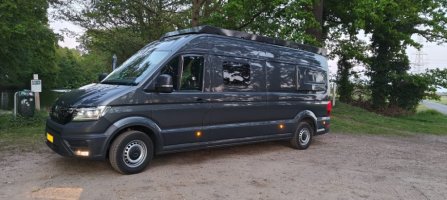
2024 MAN TGE L4H3 4x4 build

@Raul a/3 I do, however, I ordered the wrong JK BMS as the current one has no CAN-connector, so in due time (end of or next year) I will replace with a CAN-enabled model. It will have to pass through 100A max (=2400W extraction from the battery, delivering +-2000W at the Siemens induction hob).

The cells are fantastic, they'll be inside the van in the first year, up to the moment the prototyping for the heat exchanger is finished and the housing is designed and produced and it will move to its definitive place of domicile, under the van.
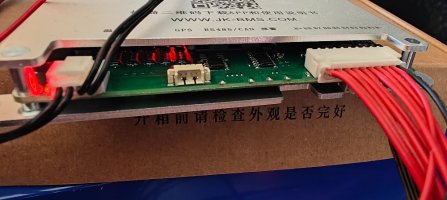
JK BMS__NO-CAN.jpg
 
Last edited:
You can still get a rs485 module, for that bms, to plug in that socket for monitoring purposes. You can even plug it into a victron GX via rs485 to USB. It brings the battery data to the GX.

On the V19 version with CAN; I would upgrade it ASAP, they do a 200 and 300A.
Reason is, along with CAN it has a solid screw heating terminal, with heat settings and logic built in the bms. It can take care of heating, if you plan the battery for outside. And it uses 4 heat sensors, combined with mos fets temperature. Much more advanced. The version you have now, it is basic plus active balance. Nothing wrong with that, it just makes it more difficult with external hardware to implement the heating.
 
Updates galore:

"Make a roof plan," they told me at the beginning. That was the holy grail to start with — the baby step that everything else would depend on. And you know what? It turned out to be completely true.

Lots of solar panels provide flexibility, meaning you never have to hook up to shore power. This makes much more adventurous travel possible. A roof rack also gives you way more options than mounting panels directly on the van’s roof. Plus, you can mount extra lights and caravan rails on the roof rack, so suddenly you don’t need a heavy 40 kg cassette awning anymore — just a lightweight 3 kg tarp is enough.


What I’m focusing on now:


  • Autarky as the starting point
  • As much weight as possible low in the vehicle, so anything that goes on the roof has to be lightweight
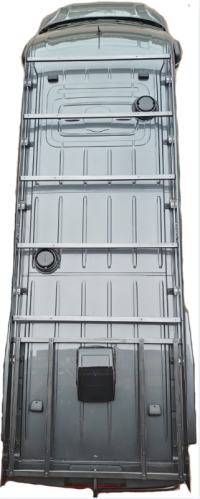
  • 1x MaxxFan Dome diagonally above the kitchen area — makes cooking inside possible in winter
  • 1x MaxxFan Dome above the toilet/shower area — creates a drying room for wet clothes and ventilates the shower and toilet
  • 1x MaxxFan Deluxe Compact Smoke above the transverse bed — for a cooling breeze in summer
  • 4x Scanstrut DS-H-MULTI-BLK cable glands (for 16 cables in total). There’s already a factory cable gland in the middle of the van near the reversing camera.
  • Roof rack (design and build) by VNK (Jeroen, on the Dutch camper forum), based on a Crafter/TGE L4 3D model and modified so two MaxxFan Domes can fit underneath the panels, plus everything that follows:
  • Space for four 200Wp Craig Solar solar panels
  • Various mounting points for lights on the roof rack (emergency lighting in case of breakdown, side floodlights to see sideways, and rear spots to see where you’re going in the dark)
  • Provision for a box (left rear) to carry a kinetic rope, shackles, and snow chains
  • Provision for mounting 4x recovery boards (right rear) with a Starlink on top
  • And lightweight: while a roof rack often weighs 55 kg, this one is only 14.7 kg


MaxxFans geplaatst.png
 
It was made by Jeroen, based on his Ford Transit L3 roof rack, but adapted using a 3D model of the Volkswagen Crafter / MAN TGE L4.

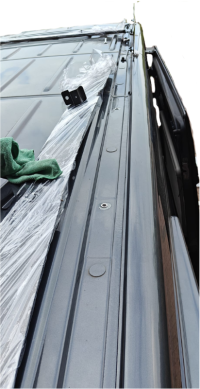
Jeroen and I took multiple measurements in the summer of 2025 to determine how wide the valley/gutter is between the roof and the sides of the van, how much the roof slopes downward, and the exact spacing and slope between the factory roof holes.

These holes measure 9.8 mm in diameter and are suitable — without any modifications — for running a bolt and nut through them to secure the brackets. This is because the Crafter / TGE, unlike the Transit, does not have threaded inserts to screw into. Ideally, it would have had threaded blind holes that would also keep water out.

RVS Blindklinkmoeren .png
There are now 12 of these nuts in the roof, which means the rack can’t blow off. And if I ever need to disassemble anything, I don’t have to remove the interior cladding on the inside.

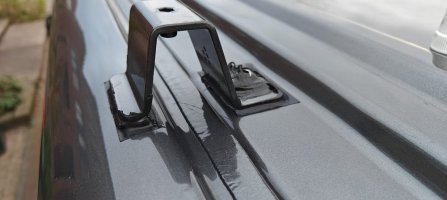
Beugel.jpeg
Bracket number five, counted from the front. The bracket has approximately 2 mm of clearance between the underside of the bracket and the top of the roof. This allowed the Sikaflex 554 to create a proper watertight seal.

The top of the washer and bolt have also been generously covered with sealant to prevent water ingress — prevention is better than cure. The outer part rests only on a thin layer of Sikaflex.


Dakrek RV.png
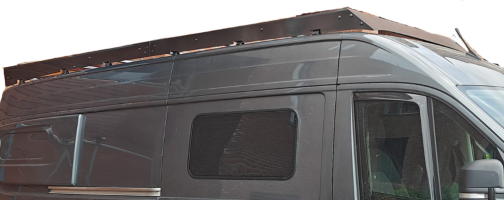
That's how it looks from the side.
 
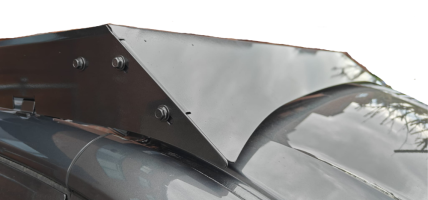
Detail of the spoiler: All the bolts and nuts have also been powder-coated. The colour is not RAL7016 but Anthracite, on the advice of Chris van Gelder from Instagram. I’m really pleased with the colour. It matches the Indium Grey of the van itself quite well.

Why didn’t I want black parts? Black creates more contrast against the van and makes you stand out more. At dusk, I just want to be another grey van on the road — not a camper with noticeable add-ons.

Spoiler.png

And this is what the whole van looks like: I had a BBQ along the canal between Beek and Bocholt in Belgium — a beautiful spot, right in the setting sun.
Dakrek LV.jpeg

The parts (roof rack, wheel carrier, and luggage rack) could also have been regularly painted, but that would have been significantly more expensive. Powder-coating is much stronger, which I considered especially important — I want the coating to stay intact even after a hit from something sharp.

I’ll be finishing the roof this week and remounting the panels. First I’ll clean the roof thoroughly and apply wax, so it stays moss-free for as long as possible.

A photo of the preliminary result will follow soon.
 
Back
Top